


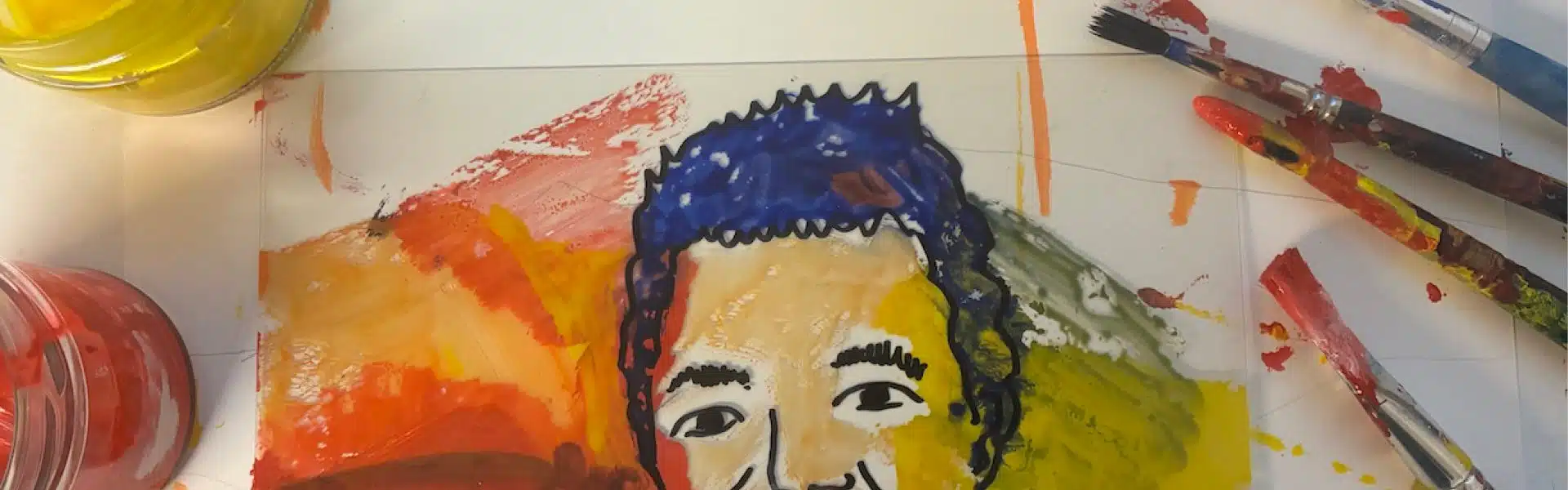
On 31 October 2026, the Werkstatt für Kreative took part in Kinder Kultur Monat. In the workshop ‘A Picture of Myself’, participants will discover fascinating images and artworks in the exhibition ‘Vietnam. Kunst. DDR. Reclaiming Solidarity’. Inspired by the artworks, everyone will get creative themselves in the Werkstatt für Kreative. Using paper and pencil, they will learn step by step how to draw a portrait. The sketch is transferred onto an acrylic panel using a black marker pen and then coloured in using Jaxon oil pastels or acrylic paints. A motif from the Berlin cityscape is placed behind the finished portrait, and the two are joined together with colourful adhesive tape. Finally, everyone can take their colourful masterpiece home with them. More information and registration: Kinder Kultur Monat
On 10th of October 2026, the 16th Family Night took place, and the Werkstatt für Kreative was once again taking part from 5 pm to 7 pm. For our workshop programme ‘A Night at the Museum and the Werkstatt für Kreative”, we were delighted to welcome 8 children aged 6–12 and 7 adults to the Werkstatt für Kreative.
After a brief welcome and a tour of the exhibition ‘Vietnam. Kunst. DDR. Reclaiming Solidarity’ at the Stiftung Kunstforum Berliner Volksbank, all participants got creative in the Werkstatt für Kreative itself. In the ‘Portrait Drawing’ workshop, everyone learnt, step by step and with a few handy tips, how to create a drawing of themselves. The sketch was transferred onto an acrylic panel, coloured in with acrylic paints, set against a backdrop of a cityscape of Berlin, and assembled into a framed picture using colourful adhesive tape. Everyone was allowed to take their little work of art home with them.
During the week of 13 to 17 July, we had the great pleasure of welcoming just under 20 children from the Pichelswerder Straße shared accommodation centre to the Werkstatt für Kreative.
Our art educators, Lilla and Rocío, led the children, aged between 6 and 12, through an artistic and creative programme for three hours each day.
Based on the workshop programme from the first half of the year, “Stadtgesichter. Selbstportraits hinter Glas”. (City Faces. Self-portraits behind glass), the children learnt the basics of portrait drawing and then applied these skills to their own self-portraits. They transferred these onto an acrylic panel, coloured them in and set them against a cityscape. Using colourful masking tape, the young artists joined their individual works together to form a framed picture, which they were allowed to take home with them.
In the second part of the workshop, the art educators worked with the children to create a performance in which each child’s favourite character was the main protagonist. Everyone was allowed to tell a story about their character – whether fictional, human or animal – and to highlight its distinctive features.
For the performance, the participants made plaster masks, which were decorated with various materials to match their favourite characters. Using the masks, their own choreography and music, they created a dance performance which the children performed with great enthusiasm in the nearby Lietzenseepark. Each mask was showcased in a photo shoot, resulting in some fantastic photos.
It was a successful and thoroughly enjoyable holiday week, during which the children were able to express themselves and further develop their understanding of art.
Workshop program from 14 September to 4 December 2026, running alongside the exhibition Vietnam. Art.GDR. Reclaiming Solidarity
The exhibition explores the artistic and cultural exchange between Vietnam and the GDR from the 1950s until the end of the GDR in 1990, as well as its aftereffects in contemporary art. In this context, textiles are presented as a culturally, socially, and economically interconnected practice. At its core are artworks that examine the living and working conditions of Vietnamese contract workers in East Germany. Between labor migration, state control, and the demands of socialist production structures, they illuminate individual experiences and collective memories. In doing so, the exhibition opens a space for reflection on power relations, cultural identities, and the possibilities of personal action within social and political frameworks.

In this workshop, we approach the exhibition as a space woven from stories – interwoven with relationships, memories and historical connections between Vietnam and the GDR.
The central question is: What does it mean to connect? How do connections arise between people, materials and narratives? We work with various materials – fabric remnants, paper, plastic and found everyday objects – and explore the Vietnamese tradition of weaving as a form of thinking with the hands.
Through experimentation, fragile, individual works emerge. Small woven pieces in which traces of origin, memory and the present overlap. In this context, material appears not merely as a medium, but as a carrier of stories that can be transformed and reassembled.
This gives rise to a process of interweaving: from many individual elements, new connections emerge that become visible, tangible and narrable.
The workshop combines conversation, perception and artistic practice – and opens up a space in which personal stories can be translated into material.
In the workshop StadtgesICHter: Gemalte Portraits hinter Glas (CityFaces: Painted Portraits Behind Glass), children playfully discover the art of portrait drawing.
After a short warm-up in the exhibition KLASSE IN WEIßENSEE! Wolfgang Peuker und seine Schüler:innen (CLASS IN WEIßENSEE! Wolfgang Peuker and His Students), in which participants feel their own faces behind a piece of paper and trace the lines they feel blindly, they receive age-appropriate assistance with proportions and facial divisions.

Older children (from class 3 onwards) place their drawing behind an acrylic plate and transfer the lines of their portrait directly onto the glass with an edding marker. The face is finished in a free and colourful style using acrylic paints.
Younger children create their portraits with soft Jackson crayons. Black-and-white cityscapes from the Kunstsammlung der Berliner Volksbank, printed on paper and placed behind the acrylic plate, serve as the background. A frame made of adhesive tape completes each individual work, creating a bright, personal cityscape behind glass that can be taken home.
Everything in the Balance
As part of KinderKulturMonat (Children’s Culture Month) on 18 October 2025, two workshops took place at the Werkstatt für Kreative. From 10 am to 12 noon, children aged 5 to 8 attended the workshop together with their accompanying adults. From 1 pm to 3 pm, we welcomed children aged 9 to 12, some of whom took part unaccompanied. Both workshops were well attended, and the accompanying adults also thoroughly enjoyed the exhibition and the creative activities they undertook together.
To begin with, the participants explored the ‘Paradise’ exhibition and set off on a journey of discovery through the diverse artworks. They looked at and discussed selected paintings together. In doing so, the children gathered ideas and impressions for their own creative project.
Back in the Werkstatt für Kreative, the participants became artists themselves: using sticks, paper and plenty of imagination, they created floating mobiles. With a little finesse, everyone found the perfect balance so that their creations could dance lightly and playfully in the air. At the end, the children proudly took their own masterpieces home with them.
On 11 October 2025, a workshop took place at the Werkstatt für Kreative from 5 pm to 7 pm as part of the Familiennacht (Family Night). A total of 24 people took part, including 13 children aged between 6 and 13.
Under the theme ‘A Night at the Museum and the Werkstatt für Kreative’, the participants first explored the current exhibition ‘Paradise’ at the Stiftung Kunstforum Berliner Volksbank together with our museum educators. They took a closer look at selected artworks and discussed them. The impressions and ideas gained during this session served as inspiration for the creative activities that followed.
Back at the Werkstatt für Kreative, the participants designed their own floating mobiles. To do this, they first constructed a frame using sticks and string. They then drew various shapes, plants, houses, objects or body parts on paper – motifs that had particularly caught their eye during the tour of the exhibition. The cut-out elements were attached to the frame with string.
Finally, the task was to balance everything carefully so that the branches hung horizontally and the mobile found its equilibrium. The resulting works of art were then allowed to be taken home.
Searching for clues and new image ideas with ink
Our world is full of contrasts: detail meets the big picture, unity meets strangeness. Based on the exhibition ‘PARADISE. Cityscape as a Mirror of Time’, this workshop invites children and young people to embark on a creative search for clues – with pencils, ink and an open eye for the inconspicuous and invisible.
What happens when we look at just one detail?
The starting point is a small section – a fragment of a work of art. In the exhibition, participants independently select a detail, which they view through a peephole and trace precisely.


Experimenting with ink and tools
Back in the workshop, the playful exploration of materials begins: ink meets unusual drawing utensils such as feathers or homemade brushes. The focus here is on trying things out, changing them and expanding them.
From detail to new artwork
In the second part of the workshop, participants work with a copied image detail – a fragment from an exhibition piece. This becomes the starting point for a new drawing composition. Lines, structures and patterns are continued, broken or reinterpreted. In this way, the original detail merges with a self-created visual world – the fragment becomes part of a larger whole. The focus is on artistic questions: When is an image ‘enough’? What happens when we exaggerate, condense or abstract a work of art? And how much of the original actually remains – or does something completely new begin here?
Creatively exploring social issues
The workshop picks up on central themes of the exhibition: possession, alienation, loss, search. These are questioned creatively and translated into individual images – beyond conventions and with room for personal perspectives.
Who is the workshop suitable for?
The offer is aimed at kindergarten groups and school classes aged 5-18. The theoretical input and artistic requirements are adapted to suit the age group.
From 28 July up to and including 1 August, the Werkstatt für Kreative will be opening its doors daily from 10 am to 1 pm for children from the Pichelswerderstraße shared accommodation. We look forward to welcoming them from 10 am to 1 pm for art and creative activities in the Werkstatt für Kreative and hope to give them a wonderful, creative first week of the summer holidays. Our independent museum educators will be taking around 20 children aged 6-12 to visit the summer children’s exhibition at the Stiftung Kunstforum Berliner Volksbank over the 5 days. Together we will look at art from the Kunstsammlung der Berliner Volksbank and artworks by children from the Lietzensee primary school project and let them inspire us. We build a mobile out of branches and tie them together with cords. We hang a wide variety of elements on them, including exploring the body, drawing arms, legs, eyes and noses, cutting them out and hanging them on our mobile. We paint, draw, glue and perhaps model. If the weather is nice, we’ll go to the park and can draw there too. Let us surprise you. It will be a great week. We look forward to seeing all the children.
In the first half of 2025, Lietzensee-Grundschule was a guest at the Werkstatt für Kreative for the second time for a long-term project. Classes 2a and 4b were able to gain artistic experience over several weeks in nine and eleven consecutive workshops respectively – led by experienced art educators in an age-appropriate manner.
The aim was to give the children space for their own forms of expression, to sharpen their aesthetic perception and to encourage them to actively engage with art. Regular visits to the current exhibition MENSCH BERLIN at the Stiftung Kunstforum Berliner Volksbank also contributed to this. The children were allowed to express their thoughts on the exhibited works, learned about various artistic techniques and developed their own ideas. The focus was on themes such as the body, the world of thought, urban experience and community.
The combination of art education and the freedom to experiment with different materials resulted in imaginative works – from body drawings and personal stamps to a large map of the neighborhood and giant mobiles.
The highlight of the project was the vernissage on June 26, 2025, where the young artists were proud to present their works to their families. The students prepared their own presentation with short speeches, which they gave themselves. This enabled them to leave their comfort zone and surpass themselves in an interdisciplinary way outside of their artistic activities.
Long-term projects such as this one enable deep immersion in artistic processes. They create space for building trust, promote creative self-efficacy and strengthen social skills. The children not only develop artistically, but also learn how to talk about art, listen to each other, develop ideas and find solutions together.